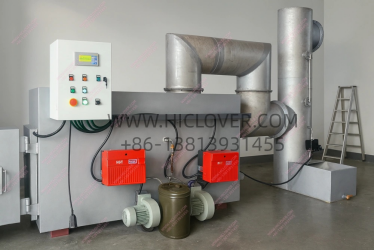
Remote and Underserved Regions: On-Site Waste Incineration Solutions
One of the primary deployment areas for small incinerators is in remote and underserved regions. In many low-income countries, rural hospitals and clinics are located far from any centralized waste treatment plant. Even in moderately populated areas, transporting infectious waste to distant facilities can be logistically difficult and costly[16]. As a result, on-site incineration becomes a practical necessity. A compact medical waste incinerator installed at a provincial clinic can immediately dispose of sharps, blood-soaked materials, or expired medications, protecting staff and community members from exposure. Crucially, it also curtails the common practice of open-air burning or dumping of medical waste, which poses severe health and environmental hazards. (Open burning releases harmful smoke and pathogens, whereas a properly designed incinerator confines and treats the emissions.)
The value of incinerators in these settings is reflected in market demand: small-scale units see consistent use in areas with limited waste infrastructure[4]. For example, a rural health center might generate only a few dozen kilograms of infectious waste per day – an amount well within the capacity of a small incinerator (say, 20–50 kg/hour throughput). Units can be fueled by diesel or gas, and modern designs require only minimal electricity (for blowers or control systems), which is ideal for locations with weak power grids. Some models are built on skid mounts or trailers, allowing them to be delivered to villages that lack any waste services and set up with minimal construction[17]. International guidelines for primary healthcare facilities in low-resource settings explicitly list incineration (in a single or double-chamber unit) as an acceptable and safe disposal method, as long as it is done in a controlled device (with no open burning)[18]. In remote regions of countries like Papua New Guinea, UNDP has helped install small incinerators (~30–50 kg/hr capacity) at rural clinics, which immediately improved local waste handling and reduced infection risks[19]. By treating hazardous waste at the point of generation, these communities avoid the need to haul dangerous materials over long distances and can maintain safer conditions even with limited resources.
2025-12-11/11:12:19
|
Incinerator Items/Model |
HICLOVER TS100(PLC)
|
|
Burn Rate (Average) |
100kg/hour |
|
Feed Capacity(Average) |
150kg/feeding |
|
Control Mode |
PLC Automatic |
|
Intelligent Sensor |
Continuously Feeding with Worker Protection |
|
High Temperature Retention(HTR) |
Yes (Adjustable) |
|
Intelligent Save Fuel Function |
Yes |
|
Primary Combustion Chamber |
1200Liters(1.2m3) |
|
Internal Dimensions |
120x100x100cm |
|
Secondary Chamber |
600L |
|
Smoke Filter Chamber |
Yes |
|
Feed Mode |
Manual |
|
Burner Type |
Italy Brand |
|
Temperature Monitor |
Yes |
|
Temperature Thermometer |
Corundum Probe Tube, 1400℃Rate. |
|
Temperature Protection |
Yes |
|
Automatic Cooling |
Yes |
|
Automatic False Alarm |
Yes |
|
Automatic Protection Operator(APO) |
Yes |
|
Time Setting |
Yes |
|
Progress Display Bar |
3.7 in” LCD Screen |
|
Oil Tank |
200L |
|
Chimney Type |
Stainless Steel 304 |
|
1st. Chamber Temperature |
800℃–1000℃ |
|
2nd. Chamber Temperature |
1000℃-1300℃ |
|
Residency Time |
2.0 Sec. |
|
Gross Weight |
7000kg |
|
External Dimensions |
270x170x190cm(Incinerator Main Body) |
|
Burner operation |
Automatic On/Off |
|
Dry Scrubber |
Optional |
|
Wet Scrubber |
Optional |
|
Top Loading Door |
Optional |
|
Asbestos Mercury Material |
None |
|
Heat Heart Technology(HHT) |
Optional |
|
Dual Fuel Type(Oil&Gas) |
Optional |
|
Dual Control Mode(Manual/Automatic) |
Optional |
|
Temperature Record |
Optional |
|
Enhanced Temperature Thermometer |
Optional |
|
Incinerator Operator PPE Kits |
Optional |
|
Backup Spare Parts Kits |
Optional |
|
Mobile Type |
Optional:Containerized/Trailer/Sledge Optional |