Cabo Verde Waste Incinerator Market Report: Island Logistics, Tourism Pressure, and Healthcare Waste Compliance
(Praia – Mindelo – Santa Maria – Assomada – São Filipe – Porto Novo)
1) Market snapshot: why Cabo Verde is a “small-island, high-visibility” incineration market
Cabo Verde (Cape Verde) behaves differently from large mainland waste markets. Demand is shaped by limited landfill space, inter-island transport costs, and tourism-driven expectations—especially around Praia (Santiago) and Mindelo (São Vicente), plus tourism nodes such as Santa Maria (Sal).
Recent World Bank materials describe waste disposal practices that still rely heavily on open-air landfills/dumpsites, highlighting the operational gap and the need for more controlled treatment for specific waste fractions. (World Bank)
At the same time, a World Bank circular economy diagnostic emphasizes strengthening circularity and reducing problematic streams (like single-use plastics), which indirectly pushes incineration toward targeted use rather than “burn everything.” (开放知识库)
What this means commercially in Cabo Verde: incineration demand is strongest when it solves a logistics and compliance problem, not when it tries to replace the entire municipal system.
2) Where real demand concentrates in Cabo Verde
A) Healthcare waste (the most bankable segment)
Healthcare waste management in Cabo Verde—particularly in Praia—is a persistent operational topic. A detailed case study focused on Dr. Agostinho Neto Hospital in Cidade da Praia examines hospital waste practices and highlights the system-level importance of compliant treatment.
Project documentation linked to World Bank financing has also required infection control and healthcare waste management planning, reinforcing that medical waste treatment is treated as part of essential health system readiness. (World Bank)
In practical terms, demand clusters around:
-
Central hospitals and labs in Praia
-
Facilities serving Mindelo
-
Secondary hubs such as Assomada, São Filipe, and Porto Novo where transport to central treatment points is expensive
B) Port, airport, and tourism corridor waste (selective, compliance-driven)
Cabo Verde’s economy has strong tourism exposure (e.g., Santa Maria) and critical transport gateways. This makes visible pollution and nuisance issues higher-stakes than in many inland markets. The result is growing interest in controlled destruction of sensitive waste fractions (confidential, regulated, contaminated materials) rather than general MSW incineration.
C) Program-driven upgrades influenced by UN agencies and development partners
UN system communications describe multi-agency collaboration around innovation and sustainability in Cabo Verde, which typically comes with stronger expectations for governance, traceability, and environmental safeguards in public services.
World Bank work on circular economy and solid waste also reinforces a shift toward better systems rather than ad hoc disposal.
3) Market trends: what is changing in Praia, Mindelo, and beyond
Trend 1 — Targeted treatment becomes more realistic than mass incineration
Cabo Verde is moving toward diversion and circularity to protect landfill capacity, which makes incineration most defensible for regulated/high-risk fractions (healthcare waste, contaminated materials) rather than mixed MSW.
Trend 2 — More documentation, more “audit language”
Healthcare projects increasingly require documented plans for infection control and medical waste handling—this raises the value of suppliers who can provide SOPs, commissioning checklists, training, and maintenance schedules. (World Bank)
Trend 3 — Inter-island logistics pushes demand toward deployable, low-civil-work systems
Island operations punish downtime. If an incinerator fails in São Filipe or Porto Novo, getting parts and technicians can take time and money. Buyers therefore prioritize:
-
robust design
-
predictable consumables
-
simplified maintenance access
-
repeatable training
4) Fit test: what type of incinerator makes sense in Cabo Verde
Best-fit configuration
For Cabo Verde, the “most sellable” technical pattern is typically:
-
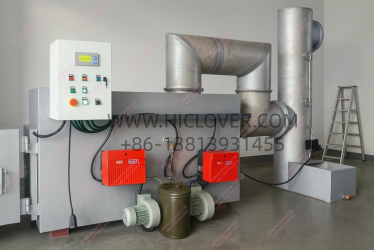
Primary combustion + secondary combustion (two-stage) to reduce smoke complaints and improve burn-out quality in high-visibility settings
-
Operator-friendly controls (reliability beats feature complexity)
-
A configuration approach that supports healthcare waste treatment routines and documentation needs
Where wet scrubbers fit (and where they don’t)
Wet scrubbers can be effective but create a new dependency: water supply + wastewater handling. For some islands and sites, this can be a constraint. Many projects therefore start with a robust two-stage combustion baseline and add gas-treatment modules only where utilities and discharge management are clearly feasible.
5) HICLOVER positioning for Cabo Verde
Cabo Verde is a strong-fit market for a supplier that can frame incineration as compliant, dependable, and logistics-aware—especially for healthcare waste and sensitive institutional streams.
HICLOVER advantages to highlight
-
Two-stage combustion options (primary + secondary chamber) for better burn-out and reduced visible emissions risk
-
Containerized / deployable solutions that reduce heavy civil works and shorten commissioning time—useful for rollouts from Praia to Mindelo and secondary hubs
-
Scalable selection for clinic-to-hospital growth patterns, aligned with program-based upgrades and documented HCWM expectations (World Bank)
HICLOVER keyword links (3–5 core anchors)
-
Containerized Mobile Incinerators: https://www.hiclover.com/containerized-mobile-incinerators/
-
Double Combustion Chamber Containerized Mobile Incinerator: https://www.hiclover.com/double-combustion-chamber-containerized-mobile-incinerator-2/
-
Containerized Hospital Waste Incinerator (CA100): https://www.hiclover.com/containerized-type-pre-assembled-mobile-hospital-waste-incinerator-model-ca100/
-
Medical Waste Incinerator Models (TS Series Overview): https://www.hiclover.com/backup/hiclover-ts-model-incinerator-2/
6) Cabo Verde-specific theme to differentiate
Theme: “Inter-island serviceability package”
In Cabo Verde, the winning offer is often not just the incinerator—it is a continuity plan:
-
standardized operator training for Praia and Mindelo
-
a spares/consumables kit sized for island lead times
-
simple record-keeping templates that match healthcare project expectations
-
predictable maintenance routines that reduce emergency breakdowns
This theme matches the country’s reality: limited redundancy, high reputational stakes in tourism zones, and increasing program expectations around environmental performance. (World Bank)
Conclusion
Cabo Verde, led by Praia and Mindelo and supported by hubs like Santa Maria, Assomada, São Filipe, and Porto Novo, is best understood as a market where incineration demand is strongest for healthcare and regulated waste streams, not for burning all municipal waste. With continued pressure on dumpsites and stronger project documentation requirements, solutions that combine two-stage combustion, deployable formats, and island-ready maintenance discipline are the most commercially and operationally realistic path. (World Bank)
Résumé en français
Le Cabo Verde, avec Praia et Mindelo comme pôles principaux (et Santa Maria, Assomada, São Filipe, Porto Novo comme centres secondaires), présente une demande d’incinération surtout liée aux déchets médicaux et aux flux réglementés. Les contraintes insulaires (logistique, coûts, continuité de service) et les exigences croissantes de documentation orientent le marché vers des systèmes robustes, faciles à exploiter, souvent à double chambre de combustion, accompagnés de formation et d’un plan de pièces/maintenance adapté aux délais inter-îles.
2025-12-12/10:41:51
|
Incinerator Items/Model |
HICLOVER TS100(PLC)
|
|
Burn Rate (Average) |
100kg/hour |
|
Feed Capacity(Average) |
150kg/feeding |
|
Control Mode |
PLC Automatic |
|
Intelligent Sensor |
Continuously Feeding with Worker Protection |
|
High Temperature Retention(HTR) |
Yes (Adjustable) |
|
Intelligent Save Fuel Function |
Yes |
|
Primary Combustion Chamber |
1200Liters(1.2m3) |
|
Internal Dimensions |
120x100x100cm |
|
Secondary Chamber |
600L |
|
Smoke Filter Chamber |
Yes |
|
Feed Mode |
Manual |
|
Burner Type |
Italy Brand |
|
Temperature Monitor |
Yes |
|
Temperature Thermometer |
Corundum Probe Tube, 1400℃Rate. |
|
Temperature Protection |
Yes |
|
Automatic Cooling |
Yes |
|
Automatic False Alarm |
Yes |
|
Automatic Protection Operator(APO) |
Yes |
|
Time Setting |
Yes |
|
Progress Display Bar |
3.7 in” LCD Screen |
|
Oil Tank |
200L |
|
Chimney Type |
Stainless Steel 304 |
|
1st. Chamber Temperature |
800℃–1000℃ |
|
2nd. Chamber Temperature |
1000℃-1300℃ |
|
Residency Time |
2.0 Sec. |
|
Gross Weight |
7000kg |
|
External Dimensions |
270x170x190cm(Incinerator Main Body) |
|
Burner operation |
Automatic On/Off |
|
Dry Scrubber |
Optional |
|
Wet Scrubber |
Optional |
|
Top Loading Door |
Optional |
|
Asbestos Mercury Material |
None |
|
Heat Heart Technology(HHT) |
Optional |
|
Dual Fuel Type(Oil&Gas) |
Optional |
|
Dual Control Mode(Manual/Automatic) |
Optional |
|
Temperature Record |
Optional |
|
Enhanced Temperature Thermometer |
Optional |
|
Incinerator Operator PPE Kits |
Optional |
|
Backup Spare Parts Kits |
Optional |
|
Mobile Type |
Optional:Containerized/Trailer/Sledge Optional |